
|
|
|
|
July 2016 Article of the Month
Park, C. L., Masters, K. S., Salsman, J. M., Wachholtz, A., Clements, A. D., Salmoirago-Blotcher, E., Trevino, K. and Wischenka, D. M. "Advancing our understanding of religion and spirituality in the context of behavioral medicine." Journal of Behavioral Medicine 40, no. 1 (February 2017): 39-51. [This article was originally featured ahead-of-print.]
SUMMARY and COMMENT: This month's featured article "provides an overview of the state of the field" [p. 40] of religion/spirituality (RS) & health, broadly examining the "knowledge to date...and...what remains to be done" [p. 40]. A collaborative effort of authors from eight institutions in the US, it lays out for researchers major challenges (and suggests possible ways of dealing with them), but it's also an important article for clinical chaplains by contextualizing well the research literature. Crystal L. Park and colleagues paint a picture of the "daunting methodological challenges inherent in this field of study" [p. 40], like the very conceptualization of R/S and, "[a]ssuming that a reasonable definition for RS can be agreed upon, the problems of how to rigorously measure and operationalize RS as well as disentangle RS from other factors" [p. 45], plus the difficulty of establishing strong causal relationship in light of the practical reality that "it is not possible to randomly assign individuals to particular RS beliefs or views" [p. 45]. Even then, there are ethical questions about the application of R/S interventions. However, the authors offer encouragement, saying, "Although daunting, these difficulties are neither insurmountable nor unique to RS as they are common in many of the social sciences" [p. 45], as in the study of personality factors and marital relationships. The authors set the stage for their analysis by summarizing key aspects of research around cardiovascular disease, cancer, and substance abuse --areas of great health concern and also where "the most significant research involving important RS constructs has been conducted" [p. 40]. While the research on these topics is described as "provocative and suggest a potential benefit of RS on multiple physical health and health-relevant outcomes," the authors note that "these data are complex and thus greater understanding is needed" [p. 43]. In light of the state of the science in these areas, they then address future directions, anticipated barriers, and research recommendations by looking at issues of conceptualizations, mechanisms, moderators, and methodology. Among their points:
Another feature of the article is the authors' general conceptual model used to frame their discussion, which they describe as "a simple yet elegant approach to organizing research" [p. 45] and "a useful guide in future efforts to study the complex relationships among RS and health outcomes" [p. 40]. It is represented in the following figure [--see p. 41]:
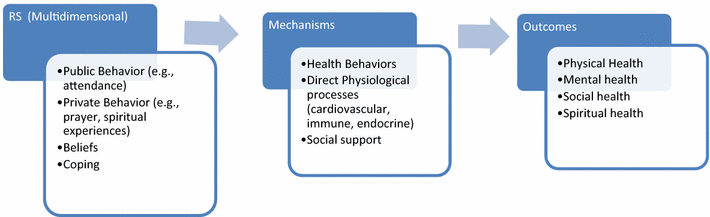
"The present model illustrates important issues regarding links between RS and health: (a) RS comprise many diverse and varied constructs, (b) the mechanisms through which RS may influence health-related outcomes are likewise varied, and (c) a range of health-relevant outcomes may be influenced by RS" [p. 40]. (Note that the figure "presents examples of some of the most widely-researched RS dimensions, mechanisms and health-related outcomes rather than attempting to provide exhaustive lists" [p. 41, caption].) This reader particularly appreciated the authors' clear explanation of their use of "RS" as a valuably inclusive term for discussing the current state of the field: "RS collectively represents a constellation of important affective, behavioral, and cognitive variables that may affect the feelings, actions, and thoughts of people in ways that influence important health-related outcomes" [p. 40]. Also, the authors nicely set the boundaries for their work, deferring to other sources for "more comprehensive reviews" [p. 40]. The section on mechanisms seems curiously -- from this reader's perspective -- to avoid mentioning the effect of RS on healthcare decision-making, though this may be somewhat implicit in the authors' comments on lifestyle choices; but overall the section on Mechanisms offers a very helpful array of references to stir researchers' thinking. The bibliography of 139 citations is an impressive collection. Some chaplains may be disappointed that there isn't emphasis here on qualitative studies, but the article demonstrates that the future direction for research in the field favors quantitative methodology. The authors conclude by expressing their hope that "we are not 'preaching to the choir' but rather reaching behavioral medicine researchers and practitioners who may or may not be particularly high in RS themselves, but who may not be aware of this large body of information on RS and health, which tends to lie outside the mainstream" [p. 47]. The article should similarly affect chaplains: not only to suggest a kind of roadmap for those already engaged in research but to inspire those whose professional commitment is to RS to be more involved with quantitative research activity. Suggestions for the Use of the Article for Student Discussion: This month's article presumes a familiarity with research per se, and thus it may be most useful with chaplaincy groups that are already exposed to the literature, perhaps at the midpoint or later in a program that has made use of a number of research articles. Nevertheless, it is written very clearly and should be quite readable for any group; its broad view makes reader-friendly even methodological points that might catch up some students when tackling individual quantitative studies. Discussion could begin with a poll of the members of the group to see if they find the article encouraging or discouraging about the prospects for research in the field, and why. Is the picture here too "daunting," or is it intriguing? Honesty about students' attitudes toward the article may uncover underlying attitudes toward research. Careful reading of the paragraph that begins at the bottom of p. 43, on trends in conceptualizations, may help the group gain a good basis for discussion of much of the rest of the article. What do students make of the Mechanisms section [pp. 44-45]? Do they favor any one sense of mechanism? Also, what's the reaction of students to the point that research needs to consider an "insider's point of view" [--see p. 46] and the example given by the authors? Can students offer their own examples of the ways that some research may seem tone-deaf or off base from their own sense of RS? If so, then how might their own insider's insight inform a research approach regarding their examples? If the section on Moderators is confusing to students, then perhaps the group could read more about moderator variables [--see Items of Related Interest, §II (below)] and return to this section in a follow-up session. Finally, can students relate the authors' thoughts about distinguishing specific RS variables to their own thinking about how to identify individual RS factors affecting a patient during a pastoral visit? Related Items of Interest: I. Our authors refer to "ecological momentary assessment" [p. 46]. The term refers to methods of in-time, in-situation data collection from study participants, which in recent years is often done through some electronic reporting device like a smartphone. A very good and recent overview of the methodology is: Robbins, M. L. and Kubiak, T., "Ecological Momentary Assessment in Behavioral Medicine: Research and Practice," chapter 20, pp. 429-446, in the Handbook of Behavioral Medicine, 1st edition, edited by David I. Mostofsky (Chichester, West Sussex: John Wiley and Sons, Inc., 2014). The Handbook is relatively rare in the US, but the chapter is available online in proof form from the OBSERVE Lab at the University of California Riverside, which is directed by the chapter's lead author, Megan L. Robbins. Older introductions to the methodology unfortunately predate the latest technologies but may still be of interest in understanding the approach and its background.
II. For a good introduction to variables for chaplains, which may help with the section of this month's article on moderators, see:
III. Our authors refer readers to comprehensive reviews of the RS literature [--see p. 40], including the great Handbook of Religion and Health, by Harold G. Koenig, Dana King and Verna B. Carson [2nd edition, New York: Oxford University Press, 2012]. However, chaplains should be aware of Harold Koenig's more recent and brief article.
IV. Our authors note the important rethinking of the domains for the Functional Assessment of Chronic Illness Therapy - Spiritual Well-Being Scale (FACIT-Sp) --a most popular measure in the RS literature. For more on this, see item #6 of our Fall 2008 newsletter and our October 2015 Article of the Month.
V. Note that lead author Crystal L. Park was also the lead author of our March 2016 AoM, co-author Kevin S. Masters was also the co-author of our December 2010 AoM, co-author John M. Salsman was also the lead author of our December 2012 AoM, co-author Amy Wachholtz was also the lead author of our December 2005 AoM, and co-author Kelly Trevino was also the lead author of our October 2014 AoM and a co-author of our May 2015 AoM.
|
If you have suggestions about the form and/or content of the site, e-mail Chaplain John Ehman (Network Convener) at john.ehman@uphs.upenn.edu
.
|